Overview

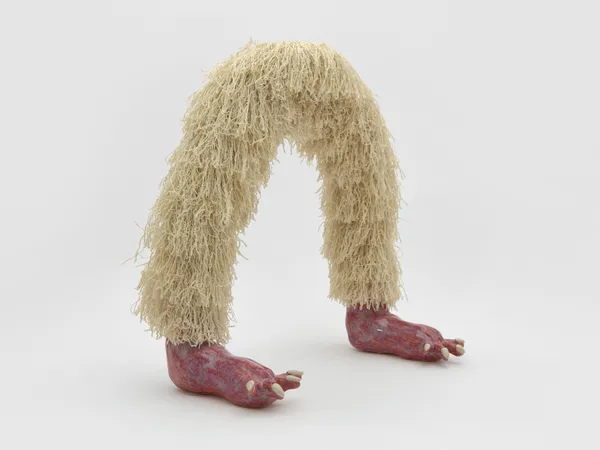
Woo Jin Joo. Satgat, 2026. Ceramic and viscose thread. Image courtesy the artist and ai.
ai. is pleased to present Ode to the Domestic by Woo Jin Joo (b. 1995, Korea; living in London), re-imagining the booth as a charged domestic interior whereby objects possess a playful haunting. Through embroidery, textile, ceramic and installation, Joo posits the home as a site of animism— where ordinary spectacle turns into revelations. The artist invokes Korean folklore’s Dokkaebi: trickster spirits born from discarded items or tools that have gained a soul through long human use. Drawing on the religious syncretism of her upbringing, Joo juxtaposes found objects alongside an artist-made quilt, a suite of amulets and enchanted "object-beings”, creating a sanctuary for meditation and the imagination.
VIP Preview: Wednesday, May 13, 10am–4pm
Contact: info@a-i-gallery.com for VIP tickets.
Public Days:
Wednesday, May 13, 4–7pm
Thursday, May 14, 11am–7pm
Friday, May 15, 11am–7pm
Saturday, May 16, 11am–7pm
Sunday, May 17, 11am–5pm
Location: The Starrett-Lehigh Building. 601 W 26th Street, 3rd Floor. New York, NY 10001. Directions: Enter on 11th Avenue, between 26th St. & 27th St.
Wednesday, May 13, 4–7pm
Thursday, May 14, 11am–7pm
Friday, May 15, 11am–7pm
Saturday, May 16, 11am–7pm
Sunday, May 17, 11am–5pm
Location: The Starrett-Lehigh Building. 601 W 26th Street, 3rd Floor. New York, NY 10001. Directions: Enter on 11th Avenue, between 26th St. & 27th St.
About the artist
Woo Jin Joo is an artist whose work delves into the boundaries of human perception, drawing from mythology, folklore, shamanism, and alternative modes of knowing. Joo explores how sculptural forms—often initiated from found or discarded objects—offer a passage into the subconscious, merging the realms of the internal and imagined with the external world. For Joo, the act of working with found elements reflects the happenstance nature of our encounters with the everyday, where even the most mundane interactions can harbour potential for transformation and creativity.
Joo graduated with an MA in Mixed Media Textiles from Royal College of Arts, London (2021). Upcoming: Communion - a performance at Victoria & Albert Museum - Friday Lates (26 June 2026). She has exhibited internationally: New Gen: The Emerging Voices with KCC London (2025), Roots, Realms and Reveries with ai. gallery (2025) & at Untitled Miami (2024), play at Ruup & Form (2024), Geen Woorden Maar Draden at Wereldmuseum, Rotterdam (2023) amongst other exhibitions. Joo is currently a Cockpit Bagri Award holder (2023), Ingram Founder's Prize Winner (2025) and Elephant Trust Award holder (2023). Her works are in private and public collections including the V&A Museum, London.
Installation Views


Press release
‘In certain almost supernatural inner states, the depth of life is entirely revealed in the spectacle, however ordinary, that we have before our eyes, and which becomes the symbol of it.’ – Charles Baudelaire
ai. is pleased to present Ode to the Domestic by Woo Jin Joo (b. 1995, Korea; living in London), re-imagining the booth as a charged domestic interior whereby objects possess a playful haunting. Through embroidery, textile, ceramic and installation, Joo posits the home as a site of animism— where ordinary spectacle turns into revelations. The artist invokes Korean folklore’s Dokkaebi: trickster spirits born from discarded items or tools that have gained a soul through long human use. Drawing on the religious syncretism of her upbringing, Joo juxtaposes found objects alongside an artist-made quilt, a suite of amulets and enchanted "object-beings”, creating a sanctuary for meditation and the imagination.
The central quilted work features the artist’s childhood t-shirt, emblazoned with the slogan: ‘Freakin Mind Reader’. On one edge, the embroidered calligraphy quotes the Heart Sutra: “Form is emptiness, emptiness is form…” Spoken by Guanyin, the bodhisattva of mercy, the scripture speaks to the profound interdependence of all reality. Surrounded by a rhythmic void of repetitive hand-stitching, the playful garment and sacred text transform the quilt into a personal shrine, stitching the domestic past into a meaningful present. Nearby, an embroidered portrait of a wrathful face, Sweetness of a Thousand Eyes, watches over the room. She echoes Guanyin’s watchful, feminine form—where each eye is a witness and each hand a gesture of salvation—serving as a protector who wards off evil and offers joy.
The vanity dresser, also a centrepiece of the installation, has its drawers pulled open in a gesture of vulnerability. Inside, rather than cosmetics, viewers encounter embroidered portraits and soft-sculpture interventions. In the diptych, Night-Eyes & Three-Leggedness, beady eyes peer from within an incense burner whilst a vessel sprouts three unexpected legs. Together, they reimagine domestic objects as thresholds between the material and the spectral worlds — objects half-waking into myth. Three-Leggedness invokes asymmetry and transformation — a creature of excess that recalls the ‘Samjok-o’, the three-legged crow of East Asian mythology. With both objects in dialogue with each other, they become an omen of mobility, mutation, and the instability of form itself. The glint of eyes peering from the drawers finds a counterpart in the oval mirror, which acts as the installation's central eye, reflecting the viewer into this spectral space and implicating them in the "haunting”.
In A Nest, a Parlour, a Dwelling-Place, the architecture of the domestic is compressed into the palm of a hand, illustrating Gaston Bachelard’s assertion that “immensity is an inner state”. The work suggests that to inhabit the smallest spaces -a corner, a room, a hand -is to realise that the soul does not require vast physical acreage to experience the infinite; it only requires the focus of a dreamer.
Hovering beside the vanity is a suite of small, embroidered works in the form of amulets. Ho-pi-do (tiger-print painting) reimagines a folk genre traditionally used to ward off evil. Encased in a ceramic “chimera” frame, this modern amulet collapses the distinction between tiger and leopard, familiar and unknown —transforming a protective ancient symbol into a charged object for our contemporary world. Next to it, Shivers, Quivers, and Silence depicts a fruit of profound symbolism, the peach is the Taoist "Peach of Immortality" and a vessel for our desires for longevity and youth. Its voluptuous form evokes feminine beauty and fertility, while its branches serve as protective talons in Korean shamanistic rituals to ward off evil. Yet, beneath its familiar, fuzzy skin, the peach harbours a sense of secrecy. It seems to quiver under our gaze—a radiant, heavy object taut with joy and fear, perpetually on the verge of bursting to reveal the hidden meanings held within.
Sat-gat -a conical hat woven from bamboo or reeds—is a quintessential object of the ordinary. Spanning from the Three Kingdoms period into the modern era, its deep eaves were designed to shield the commoner from rain and sun, or to offer a veil of anonymity to vagabonds and women alike. The Sat-gat is the perfect vessel for transformation. Folklore tells of these spirits manifesting from objects that have shared a long, intimate history with their owners. A hat that has weathered decades of labour and travel, absorbing the sweat and stories of the wearer, is no longer merely functional; it becomes a "charged" item. Much like the trickster Dokkaebi who hides in plain sight, the Sat-gat with its pair of rose-red ceramic feet serves as both a tool of protection and a mask for the unknown, bridging the gap between the humble domestic life and the supernatural realm.
Forgotten, overlooked, or perhaps hiding in plain sight— an ordinary dustpan and brush (Old Dust, Tiniest Burrows) bear the uncanny marks of a creature. Joo asks if this object, too, has become a Dokkaebi. It lingers in the domestic shadows, a silent witness whose presence feels both vestigial and recent.
Pincer-like fingers extend from the wall as Trickster, Shapeshifter, Protector appears, almost beckoning. Neither wholly good nor evil, these mythological beings take on familiar forms, mimicking human habits and gestures. They inhabit the built world—walls, corners, thresholds—guarding and revealing. In their playfulness, they disarm fear, coaxing the imagination awake. In traditional Korean belief, house gods guard the domestic realm—kitchen gods, toilet spirits, hearth deities, each occupying a specific function and doorway. Worship in these spaces was existential, not ornamental. The home became more than a shelter; it was a mythological landscape, a guardian realm where the imagination of the child could safely roam. Thus, the domestic is not mundane—it is mythic. A space where real objects turn into imaginary beings. In this way, mythology is not an escape from reality, but a deepening of it. An act of protective storytelling that allows us to live meaningfully among our fears and inner chaos.
Standing upon the feet made of black clay, a petite embroidered arch serves as a physical manifestation of Rubedo. In the mystical world of alchemy, this is the final stage of a transformative process (known as the Great Work) of base matter into gold. In Latin, Rubedo translates as ‘redness’ and it signifies the reconciliation of opposites into a unified, indestructible whole. Here, Joo translates this spiritual realisation into a "full-blooded reality." The archway itself suggests a threshold to the supernatural. By merging the mischievous, earth-bound energy of the Dokkaebi with this alchemical culmination, Joo suggests that true spiritual realisation is something lived out fully—and perhaps playfully—within the everyday.
About the artist
Woo Jin Joo (b.1996, Korea; living in London) is an artist whose work delves into the boundaries of human perception, drawing from mythology, folklore, shamanism, and alternative modes of knowing. Joo explores how sculptural forms—often initiated from found or discarded objects—offer a passage into the subconscious, merging the realms of the internal and imagined with the external world. For Joo, the act of working with found elements reflects the happenstance nature of our encounters with the everyday, where even the most mundane interactions can harbour potential for transformation and creativity.
Joo graduated with an MA in Mixed Media Textiles from Royal College of Arts, London (2021). Upcoming: Communion - a performance at Victoria & Albert Museum - Friday Lates (26 June 2026). She has exhibited internationally: New Gen: The Emerging Voices with KCC London (2025), Roots, Realms and Reveries with ai. gallery (2025) & at Untitled Miami (2024), play at Ruup & Form (2024), Geen Woorden Maar Draden at Wereldmuseum, Rotterdam (2023) amongst other exhibitions. Joo is currently a Cockpit Bagri Award holder (2023), Ingram Founder's Prize Winner (2025) and Elephant Trust Award holder (2023). Her works are in private and public collections including the V&A Museum, London.
Works
-
 Woo Jin Joo, Satgat, 2026
 -
Woo Jin Joo, Freakin Mind Reader, 2026
-
Woo Jin Joo, Sweetness of Thousand Eyes, 2025
-
Woo Jin Joo, Old Dust, Tiniest Burrows, 2026
-
Woo Jin Joo, A Nest, a Parlour, a Dwelling-Place, 2026
-
Woo Jin Joo, Trickster, Protector, Shapeshifter, 2025
-
Woo Jin Joo, Reverberation, 2025
-
Woo Jin Joo, Recollection, 2025
-
Woo Jin Joo, (i) Three-Leggedness, 2024
-
Woo Jin Joo, (ii) Night-Eyes, 2024
-
Woo Jin Joo, Ho-pi-do, 2026
-
Woo Jin Joo, Shivers, Quivers and Silence, 2026
-
Woo Jin Joo, Formation-Reformation, 2025